

Biometric Checks in Europe: Airport Queues and Delays at Risk
Europe’s new Entry/Exit System promises more digital and secure borders, but at the height of summer it is putting airports, passengers and airlines to the test. Here is what is really changing for those travelling in Europe, and how to prepare before departure.
NEWS
Rebecca P. & Raffaele F.
7/6/20264 min read
Biometric Checks in Europe: Airport Chaos and Disruption for Holidaymakers
Suitcase ready for summer? Keep an eye on airport checks.
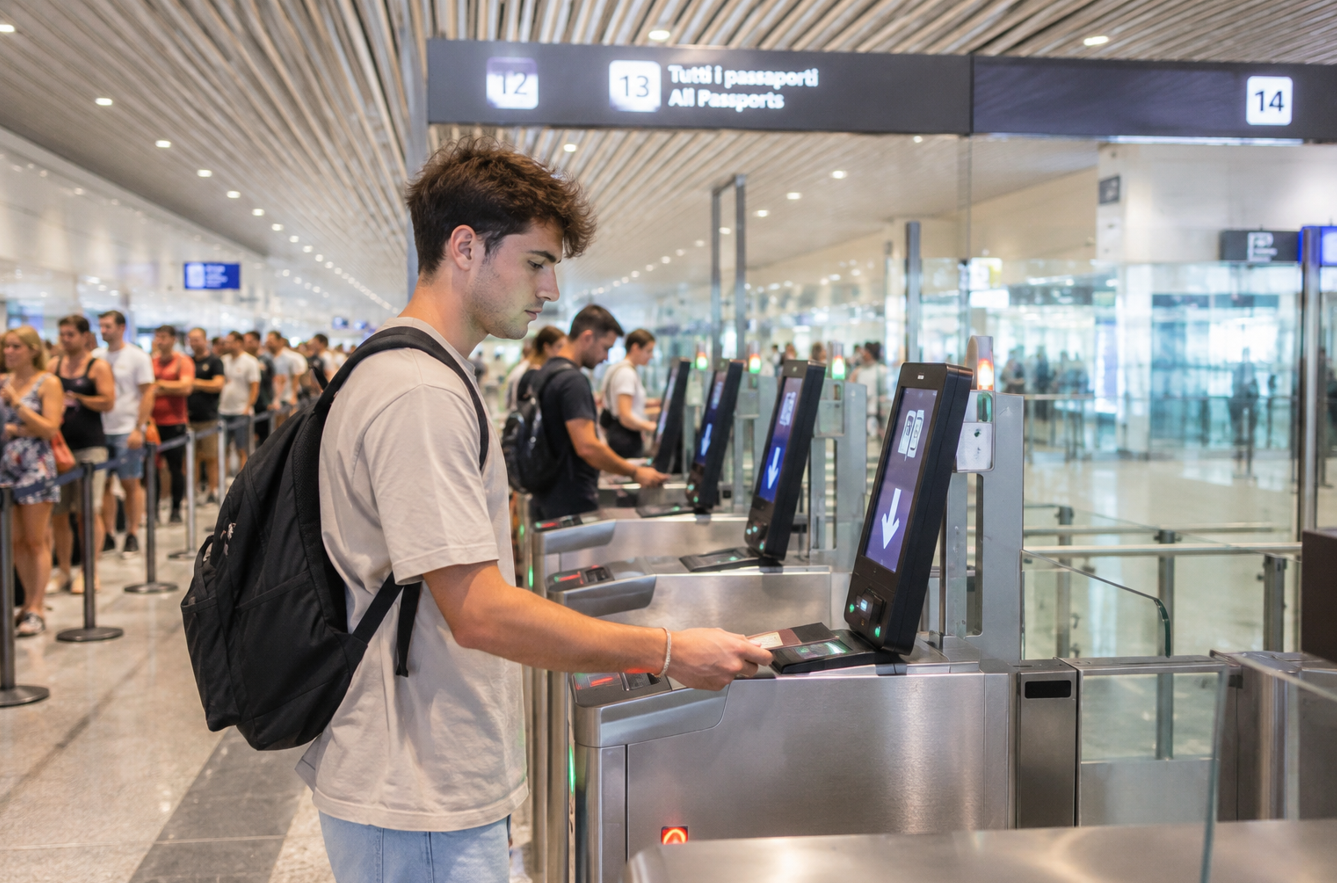
Europe is changing the way it records who enters and leaves its borders. This is not a minor bureaucratic tweak hidden in the small print, but a real, visible transformation made up of automated kiosks, facial scans, fingerprints and waiting times that, in some airports, are becoming the real unexpected setback of the summer. Its technical name is the Entry/Exit System, usually shortened to EES.
The new biometric border control system in Europe is gradually replacing the old passport stamp with a digital record.
In theory, it means more order, more security and less paperwork. In practice, at least during this first major travel season, the system is creating queues, delays and a fair amount of frustration at several European airports.
And even though not all travellers are directly affected, the news matters to anyone planning a trip to Europe, especially during peak season.
What Is the EES and Why Is Everyone Talking About It?
The Entry/Exit System is the IT system used by the European Union to record the entry and exit of non-EU nationals travelling for short stays in countries within the Schengen area. It does not therefore affect European tourists flying within the EU with a European travel document, but rather those arriving from non-EU countries, such as the United Kingdom, the United States, Canada, Australia and many others.
The change is significant because it is no longer just a matter of showing your passport. On the first crossing, travellers must register their details, have their photograph taken and, in many cases, provide their fingerprints. This information is then used to automatically check entries, exits and the length of stay, particularly the rule of 90 days in any 180-day period within the Schengen area.
On paper, the system should make future checks smoother, as once travellers are registered, subsequent border controls should be quicker. But every digital revolution has its awkward phase, and in this case, that awkward phase has arrived just as millions of people are setting off on holiday.
The Problem
The issue is not so much the idea behind the system as its impact in the real world, inside airports that are already crowded, with staff under pressure, families heading off on holiday, tight flight schedules, passengers unfamiliar with the procedure and machines that do not always work as quickly as promised.
According to aviation industry associations, waiting times at border controls in some European airports have reached several hours, even up to five during the most congested periods.
There have been reports of flights departing with empty seats, not because passengers failed to turn up, but because some of them were still stuck in border control queues. The consequences range from having to book a new flight to luggage being loaded onto aircraft without its rightful owner on board.
The biggest concerns relate to airport queues in summer, especially at airports with heavy tourist traffic.
Some airlines and airport associations have asked the European Commission for greater flexibility, including the possibility of temporarily suspending biometric checks when operational capacity is not sufficient.
This is not a definitive rejection of the system. It is more of a very practical question: does it make sense to test a new machine precisely when the road is at its busiest?
The Airports Most Exposed
The difficulties are not the same everywhere. Some airports appear to be handling the flow better, while others are struggling more. According to various reports gathered by the international press and the aviation sector, the most delicate situations are being seen at airports with a high volume of non-EU travellers and infrastructure that is not yet fully tried and tested.
Airports in Spain, France, Italy, Portugal and Greece have been mentioned, with particular attention on popular tourist airports during the summer months. More specifically, airports such as Milan Bergamo, Palma, Alicante, Málaga, Tenerife South, Krakow and Paris Beauvais have entered the debate after being identified by Ryanair as among those already exposed to major disruption.
EES, ETIAS and Passports
One of the most common mistakes is confusing EES with ETIAS.
While the EES is the entry and exit registration system designed to digitalise checks and replace the manual passport stamp for many non-EU travellers, ETIAS is instead a travel authorisation for visa-exempt citizens from non-EU third countries, similar in concept to the United States’ ESTA. The system is expected to become fully operational in the final quarter of 2026. The authorisation will cost €20, will be valid for three years and must be requested before departure.
This distinction matters because many travellers searching online for information about visas to enter Europe and the related new rules end up in a maze of partial, often contradictory and frequently incorrect information.
What to Do Before Departure
It may sound obvious, but the first essential rule is not to cut things too fine. Simply allow more time than usual.
It is worth checking the guidance from your airline and airport in the days before departure, as the situation may vary from one airport to another. In some cases, passengers are being advised to arrive earlier than usual; in others, specific procedures are being indicated for those who need to use the EES kiosks.
Avoid tight connections. They are always a gamble, especially with different airlines or separate tickets, and with the new biometric checks they can become a real game of roulette.
For non-EU travellers, it may be useful to check whether the official Travel to Europe app is available in the country of entry. The app is designed to allow some information to be pre-registered before arriving at the border. It does not replace border control, but it can make the process less slow where it is active. Here too, there are no automatic assumptions: each country may adopt it in a different way.
Last but not least, and far from obvious, make sure your travel documents are valid — passport first and foremost.
Do Not Get Lost Before You Have Even Set Off!
If you enjoy practical guides, travel updates and concrete advice, subscribe to the blog newsletter so you do not miss useful information for travelling more consciously, avoiding mistakes and discovering places that are truly worth visiting. Follow us on Instagram, Facebook and TikTok too, where we share journeys, itineraries, curiosities and little tricks to keep in your pocket before your next departure.
Because travelling is wonderful, but travelling prepared is just that little bit better.
Let us know what you think
Leave a comment
Social Link
Follow us on our social channels
Instagram, Facebook e TikTok
ContaCTS
Newsletter
© Copyright 2026 - Zaino in Due