

Sleeping in Economy? The “Lie-Flat Seat” Revolution Changing Long-Haul Flights
Airlines are transforming long-haul travel: rows of economy seats that turn into proper beds are arriving. Here’s how they work and what they mean for travellers.
NEWS
Rebecca P. & Raffaele F.
3/30/20264 min read
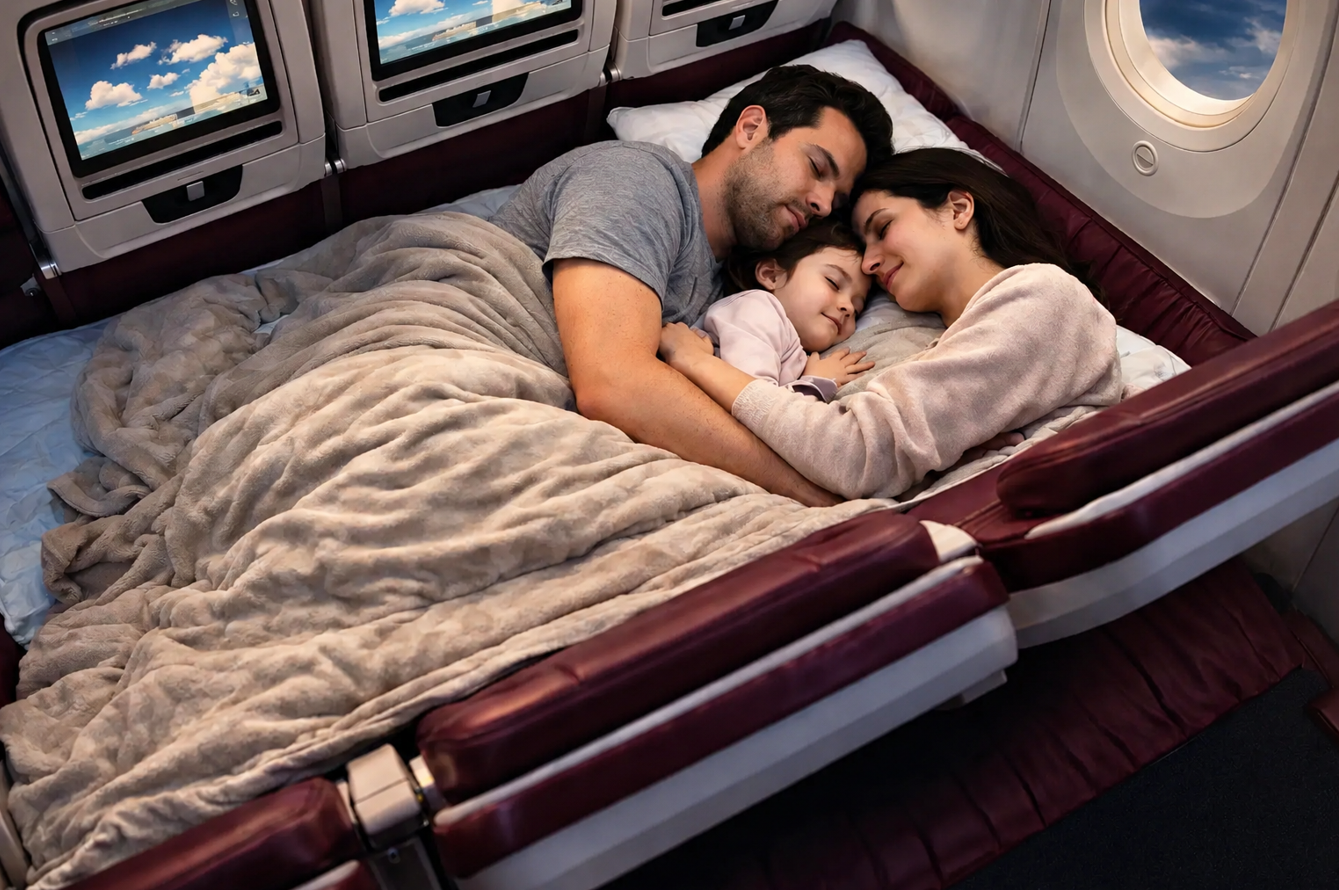
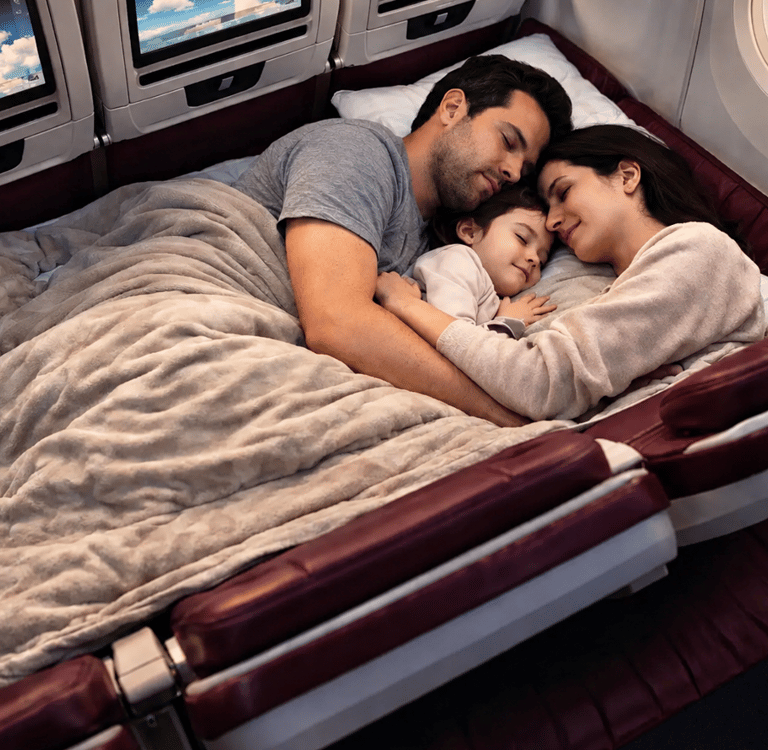
There is a small but significant revolution taking place in the skies, and this time it concerns those travelling in economy. For years, onboard comfort was almost exclusively the privilege of business and first class: reclining seats, room to stretch out, peaceful sleep above the clouds. For everyone else? Cramped knees, improvised pillows and sleepless nights.
But something is changing. And it could change the way we experience intercontinental flights forever.
In recent months, several airlines have begun completely rethinking the economy experience, introducing solutions that, until not long ago, seemed almost unthinkable: seats that turn into proper beds.
Sleeping in Economy: The New Revolution in Long-Haul Flights
A New Era for Long-Haul Flights
The latest development comes from the United States, where United Airlines has announced the introduction of a new configuration called the “Relax Row”: a row of economy seats designed to become a surface passengers can fully lie down on.
The concept is simple but brilliant: three consecutive seats, fitted with adjustable footrests and dedicated accessories, can be transformed into a sort of sofa or horizontal bed. The result? More space, more comfort and, above all, the chance to sleep properly during long flights of 10 to 12 hours.
This is not just a cosmetic gimmick. The idea is to offer an experience somewhere between economy and premium, without reaching the prohibitive costs of the higher travel classes.
How Economy “Bed Seats” Work
Unlike traditional seats, these rows are designed to adapt to the passenger’s needs: the footrests lift up to create an even surface, while a dedicated mattress pad is placed on top. Larger blankets, extra pillows and comfort kits, also designed with families and travellers with children in mind, complete the experience.
In practical terms, instead of trying to sleep sitting upright, passengers will finally be able to stretch out. And for those who often fly on intercontinental routes, that makes an enormous difference.
It is no coincidence that this solution is aimed above all at couples, solo travellers and families: groups that often look for a compromise between price and comfort.
It Is Not Entirely New — But It Is Now Going Mainstream
If this idea sounds familiar, that is because it is not entirely new: some airlines had already experimented with similar solutions in previous years.
Air New Zealand, for example, was among the first to introduce the Skycouch, an economy row that can be transformed into a sleeping space, designed especially for ultra-long-haul flights.
Other European airlines have also tested similar formulas, offering entire rows that can be booked with mattress pads and night kits on routes lasting more than 10 hours.
The difference? Today, this idea is moving from niche experiment to global trend.
Why Airlines Are Changing Strategy
Behind this innovation lies much more than a simple search for comfort. The aviation industry is undergoing a deep transformation, driven by new traveller habits.
More and more people are choosing long-haul flights for work, remote working or slow tourism. At the same time, there is growing attention on wellbeing during the journey: sleeping well, arriving rested and reducing the effects of jet lag.
Airlines are therefore trying to respond to a very clear demand: to offer a better experience without pushing prices up too much. And this is where these new hybrid configurations come in, allowing airlines to monetise space intelligently without completely redesigning the cabin.
How Much Will It Really Cost to Sleep in Economy?
One of the most interesting questions concerns the price.
At the moment, official details have not yet been fully announced, but these “convertible” rows are expected to be available for an additional fee on top of the standard ticket.
Looking at existing solutions, the cost could be significantly lower than upgrading to business class, while still being high enough to position it as a premium option.
In other words: it will not be as cheap as a standard seat, but it will not be prohibitive either.
And for many travellers, it could represent the perfect compromise.
The Future of Travel: Fewer Classes, More Flexibility?
This evolution could lead to deeper changes than we might imagine. Traditionally, aircraft cabins have always been divided into rigid classes: economy, premium economy, business and first.
New trends, however, are moving towards greater personalisation of travel packages, with airlines becoming increasingly attentive to passengers’ needs through the introduction of modular services, where you pay only for what you truly want: more space, more comfort, more privacy.
In this scenario, lie-flat economy seats could be just the beginning.
It is not at all utopian to imagine cabins that can be configured in real time, seats that adapt to individual needs, or shared spaces designed for relaxation during the flight. This is not science fiction: it is the direction in which the industry seems to be moving.
A Small Revolution That Could Become the Norm
What we are seeing today may look like a simple upgrade, but in reality it is a strong signal: the world of aviation is changing.
After years in which economy was synonymous with compromise, something is finally moving in the opposite direction: more comfort, greater attention to passengers and more hybrid solutions.
And perhaps, in a few years’ time, the idea of sleeping upright on a plane may be nothing more than a memory from the past.
Staying on the Journey Between One Departure and the Next
If you have made it this far, then perhaps, for you too, travel is not only about reaching a destination, but also about everything that happens along the way: discoveries, details, changes, trends and tips that often go unnoticed, yet can make all the difference.
If you feel like it, we can keep travelling together: simply subscribe to the newsletter to receive carefully selected ideas, news and inspiration, with no unnecessary content.
And for an even more direct, everyday point of view, follow us on Instagram, TikTok and Facebook, where we share the more spontaneous side of travel: real experiences, behind-the-scenes moments and ideas worth saving on the spot.
Let us know what you think
Leave a comment
Social Link
Follow us on our social channels
Instagram, Facebook e TikTok
ContaCTS
Newsletter
© Copyright 2026 - Zaino in Due